
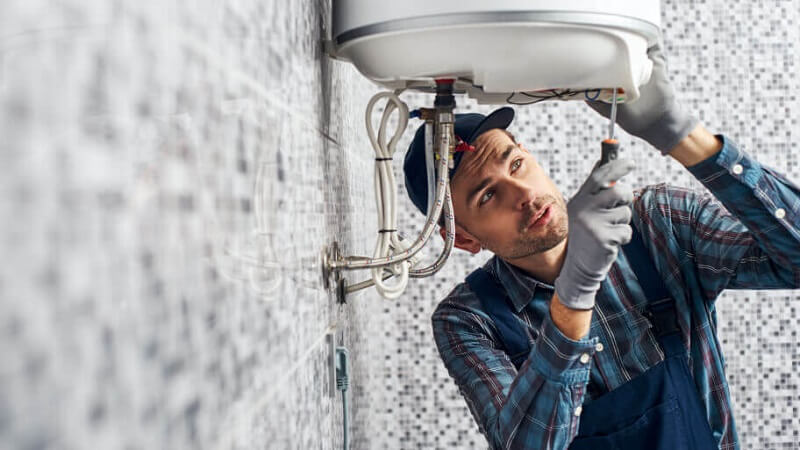
It is cold outside. You have run out of hot water. Your boiler has shut down. But take a second before you start panicking. You can safely check a few simple things.
These are easy steps that may not resolve all the problems. But they will get you to rule out all potential small problems and decide on the next step.
Double-check the thermostat
Begin with the simplest and neglected step. Is the thermostat set to heat? That should be higher than the current room temperature.
Maybe your thermostat requires new batteries. Address that. Even low-energy batteries can cause communication problems.
And also ensure that the thermostat program has not been altered unintentionally. A simple change of setting can restart your boiler.
Check the boiler pressure
The majority of boilers stop when there is insufficient pressure. Check the pressure gauge. It is generally on the front or the underside of the unit. On numerous systems, normal pressure is between 1 and 2 bars. This is when the boiler is cold.
If the pressure is below this range, you might have to fill it up. Use the filling loop. Pay attention to the manufacturer’s instructions. If the pressure continues to drop, there is a bigger problem.
Search for error codes or warning lights
Contemporary boilers are designed to alert you when something is amiss. Flashing lights or error codes may indicate problems such as:
- Ignition failure
- Low pressure
- Sensor problems.
You should not perform internal repairs. But it might be helpful to record the code. It will enable the technicians to diagnose the problem quickly during an emergency boiler repair call.
Make sure power and gas are on
This sounds obvious. But many people ignore it. Confirm that the boiler is turned on. Check that there are no tripped circuit breakers. The system can be turned off by a power outage or electrical hiccups.
Ensure also that the gas supply valve is open. Maybe you had recent work or a gas outage. There is a possibility that the supply was turned off without you noticing it.
Bleed radiators when the heat is uneven
Maybe your boiler appears to be operational. But your radiators are not getting hot. Then there is a possibility of trapped air. Easy identifiers are:
- Cold spots
- Gurgling sounds.
Bleeding the radiators discharges the trapped air. It allows hot water to move freely once again. This is how to do it:
- Switch off heating. Allow the system to cool.
- Open the bleed valve. It is at the top of the radiator. Do it slowly using a radiator key until you can hear air hissing out.
- When the hissing ceases and water begins flowing, turn the valve off.
- Check your boiler pressure after bleeding. Fill it up when
This is an easy exercise that will restore heat without costly intervention. You can also call in a professional technician to do that.
The takeaway
Not all boiler problems are complete emergencies. Take the above steps first. When these measures fail or the boiler continues to shut off, call an expert.